Cienfuegos
World War ZCienfuegos is the urban setting in which postwar Cuba displays the material and political consequences of its victory in the Zombie War. Seen from a high office overlooking the city and harbor, it appears not merely rebuilt but remade: an energy-independent metropolis, an industrial hub, and the visible face of a country that has exchanged siege conditions for wealth, mobility, and political contention.
Urban Setting and View
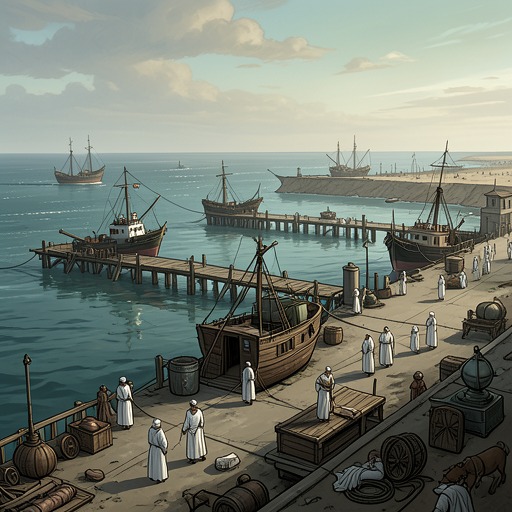
Cienfuegos is encountered through the office of Seryosha Garcia Alvarez, located on the sixty-ninth floor of the Malpica Savings and Loans building. The Malpica is identified as the second-tallest building in Cuba after Havana’s José Martí Towers, giving the interview a deliberately elevated perspective over both the glittering metropolis and the busy harbor. The setting turns the city into a panorama of national recovery, with finance, architecture, energy technology, and maritime activity gathered into one view.
The building itself is energy independent. Its photovoltaic windows catch the setting sun during the daily period described as the “magic hour,” taking on an almost imperceptible magenta hue. That detail makes Cienfuegos’s renewal concrete rather than rhetorical: the city’s modernity is embedded in its buildings and energy systems, not only in official claims about progress. The harbor below also connects the city to the wider logistical transformation of Cuba, which has become a major center of production, training, transport, and naval repair.
From Isolation to the Arsenal of Victory
Before the war, Cienfuegos belonged to a Cuba characterized by quasi-isolation and chronic deprivation. The country endured rationed food and fuel, and its condition is compared with Great Britain during the Blitz: a besieged society living beneath the constant threat of an enemy. Earlier Soviet and Comecon support had provided a form of economic welfare, but after the communist bloc collapsed, that protection disappeared and scarcity became habitual.
The war altered the city’s position within the hemisphere. Once world governments launched their counteroffensive, Cuba became the “Arsenal of Victory.” It served simultaneously as a breadbasket, manufacturing center, training ground, and springboard; it also became the air hub for North and South America and a great dry dock for ten thousand ships. Cienfuegos therefore represents a national infrastructure that has been redirected toward survival and then converted into lasting capacity. Its harbor is not background scenery but evidence of the immense scale of the wartime economy that passed through Cuba.
Economic and Social Transformation
The wartime role brought Cuba substantial wealth and produced an overnight middle class. That prosperity created demand for the refined skills and practical experience of the Nortecubanos, whose participation helped connect the island’s economic transformation to the recovery of the broader region. Cienfuegos, with its financial tower, independent energy systems, harbor, and metropolitan skyline, is the clearest architectural expression of that new class and its new economic confidence.
The city’s prosperity is also presented as reciprocal rather than purely extractive. Cuba helped the Nortecubanos reclaim their nation, while the Nortecubanos helped Cuba reclaim its own. Their influence introduced democracy and gave freedom an individual, practical meaning: not an abstract possession, but the freedom to pursue a desired life and fight for it. Cienfuegos thus occupies a postcolonial and political middle ground, where national recovery depends on exchange across former borders and on the transformation of military cooperation into civic and economic renewal.
Democracy in an Imperfect Metropolis
The city’s success does not make it idyllic. The new Latin superpower contains hundreds of political parties and even more special-interest groups, alongside frequent strikes, riots, and protests. Cienfuegos is consequently a landscape of argumentative freedom rather than harmonious unity. Its visible prosperity coexists with friction, disorder, and the difficulty of making democratic institutions function in everyday life.
That tension is central to the city’s meaning. The same national transformation that produced wealth and open political expression also produced conflict over interests and power. Democracy is valued not because it eliminates disruption, but because it allows citizens to contest the direction of their society. Cienfuegos’s skyline therefore signifies both achievement and unfinished political labor: the city has escaped deprivation, yet it must continually negotiate the consequences of freedom.
Narrative Significance
Cienfuegos functions as a compressed image of Cuba’s historical reversal. The view from the Malpica Savings and Loans building moves from a remembered world of rationing and isolation to photovoltaic architecture, a thriving harbor, and a metropolitan economy integrated with the wider Americas. The physical height of the interview location reinforces that reversal, placing the witness above a city that has become newly legible as prosperous and powerful.
The location also gives the postwar narrative a complicated emotional register. Cuba can claim victory and renewal, but its achievements emerge from catastrophe, wartime mobilization, and collaboration with outsiders. Its democracy remains noisy and unstable, while its prosperity rests on the practical skills, labor, and sacrifices of many populations. Cienfuegos is significant precisely because it holds these contradictions together: it is both a monument to survival and a working city still learning what survival has made possible.